
Locanda Argine della Cerchia B&B - Corso G. Garibaldi, 25 - 42016 Guastalla (R.E.) Italy - PHONE: +39-340-7465745
info@locandaarginedellacerchia.it - https://www.locandaarginedellacerchia.it - C.I.N.: IT035024C12TLIH8TE
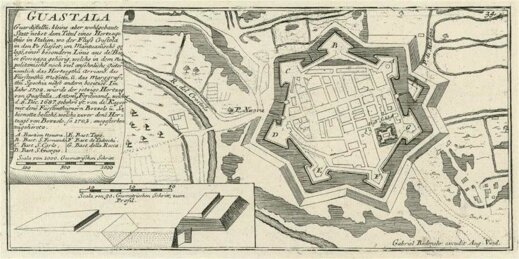
Recent archaeological findings indicate that the origins of Guastalla as the first inhabited nucleus date back to the Etruscan period. Fragments of decorated pottery of various shapes and uses, metal objects, and other more specific funerary goods are signs of an organized presence. Moreover, the river, being a wide communication route to the sea, has always been an ideal place for trade, a true sui generis highway for exchanges and transport throughout the Po Valley. Therefore, the Etruscan presence in these territories is not surprising, nor should the evidence of traces of Roman centuriation, as shown by both findings and photogrammetric surveys, seem strange.
Cookie Policy
Clear elements, as the name itself suggests, testify to its function as a "watch post" during the Lombard period. But it is in the historiographical documents of 864, where Emperor Louis II donates Guastalla to his wife Angilberga, that the name of the city appears for the first time. Then, from around the year one thousand, with the Canossa family, the settlement that arose around the Church of Pieve, having obtained the privilege of "nullius dioecesis," began to gain importance due to the presence of large cultivated areas on fertile land just a stone's throw from the Po, a strategic transit area.
Confirming the level of importance reached by Guastalla in the Middle Ages, as many as two councils were hosted in the church of Pieve, first in 1095 with Urban II, the pope of the crusades, and later in 1106 with Pope Paschal II. With the advent of the Torelli counts in 1406, the cycle of lords who dominated and created the city as an organized architectural space began, with the presence of the noble palace, the castle, the churches, and the square.
This new reality, born on the right bank of the Po, in a productive lowland area, attracted the attention of Ferrante Gonzaga, field marshal of the Emperor of Spain Charles V, who purchased it in 1539 from Countess Ludovica Torelli with the intention of making it a possession worthy of his lineage.
Under the Gonzaga dynasty, Guastalla reached its greatest splendor; renowned architects such as Giunti and Volterra were called, it hosted artists like Guercino and the Campi, poets like Tasso and Guarini; thanks to the care of its dukes, it became one of the most important fortified cities in the military chessboard of Northern Italy. This warlike connotation, which was a symbol of military power, was also the sign of its ruin. In fact, in 1689, attacked by the Spanish, it was deprived of its fortification elements such as the walls and the fortress. After that date, the city of Guastalla began a slow political and military decline; the Gonzaga were succeeded by the Bourbons of Parma, who placed it in a subordinate role; later Napoleon and Maria Luigia: borderland of the Duchy of Parma. Finally, the Risorgimento made it one of the municipalities of Italy.
In the 20th century, Guastalla shifted from a typically agricultural productive reality to an industrial and artisanal one, while maintaining those peculiar traditions tied to the land such as wine, livestock, and the production of Parmigiano Reggiano. A city where the scale allows for a particularly high quality of life, thanks to the large green spaces linked to the river, the Renaissance historic center, the available services, and one of the highest employment levels.
THE PLACES OF HISTORY
Guastalla remains a city that manages to communicate its splendid past to the eyes of the visitor. Those who enter the historic center immediately notice how much of the Renaissance still remains in the city's urban fabric: from the noble palaces to the residence of the dukes, from the churches to the road network, up to the remnants of the fortifications immersed in a large green area.
PIAZZA GARIBALDI
In Piazza Garibaldi we find some interesting buildings which, even if emptied of their original meanings, belong to the history of the city: Palazzo Frattini, home of the Municipal Cultural Center, the Monte di Pietà, the convent church of the Most Holy Crucifix (or of the Cappuccine), in the past part of the connected middle school, the octagonal church of the Blessed Virgin of the Conception.
Leaving Piazza Garibaldi and walking along Corso Prampolini you reach the intersection with Via IV Novembre, the ancient street of Palamaglio, where we find the center of the so-called Croce del Volterra: an urban crossroads that takes us back to the scheme of the ideal city in which we notice the religious presence made concrete by four churches: the Cathedral to the north, the former Church of San Carlo to the south, the Church of the Most Holy Annunciation to the east, the former Church of the Most Holy Crucifix to the west.
Locanda Argine della Cerchia B&B - Corso G. Garibaldi, 25 - 42016 Guastalla (R.E.) Italy - PHONE: +39-340-7465745
info@locandaarginedellacerchia.it - https://www.locandaarginedellacerchia.it - C.I.N.: IT035024C12TLIH8TE
Cookie Policy